The Hidden Reason Your 'Guilt-Free' Snack Still Leaves You Craving More
Healthy snack cravings can be surprisingly persistent even when the food in your hand looks like the sensible choice. You eat a low-sugar bar, a few rice cakes, a handful of dried fruit, or another snack marketed as “guilt-free,” yet the feeling of wanting something else arrives soon afterward. That experience does not automatically mean you lack discipline. Sometimes the snack solved one problem—such as providing a convenient source of energy—while leaving another problem untouched: physical fullness, sensory satisfaction, or the emotional reason you wanted food in the first place.
The more useful question is therefore not simply, “Was this snack healthy?” It is, “What was I asking this snack to do?” A snack intended to quiet physical hunger may need a different structure from one intended to satisfy a very specific sweet or crunchy craving. And a snack cannot necessarily solve an urge that began with boredom, stress, habit, or an environmental cue.
Start With This Quick Self-Check
Before changing the food, run through this short checklist. The point is not to police eating. It is to identify the missing piece so that the next decision is based on the actual problem.
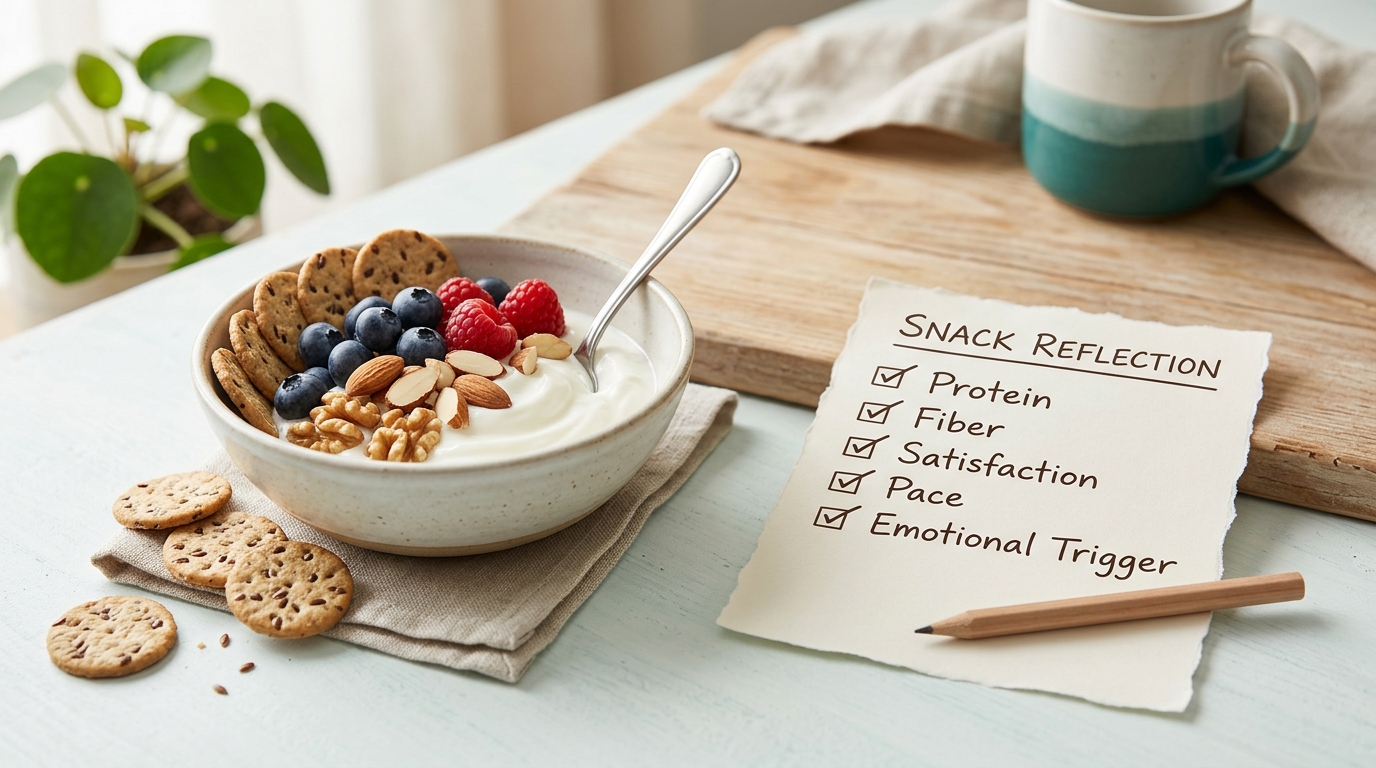
- Hunger: Do I feel physical hunger, or did I notice food because of a sight, smell, routine, screen, or emotion?
- Protein: Does the snack contain a meaningful protein-containing food, or is it mostly a quick carbohydrate?
- Fiber: Is there a naturally fiber-containing component such as fruit, vegetables, beans, nuts, seeds, or whole grains?
- Satisfaction: Am I actually interested in this food, or am I eating a substitute while mentally waiting for something else?
- Pace: Did I eat while distracted, standing, driving, scrolling, or working?
- Context: Is this snack replacing a missed meal, or is it a small bridge between meals?
- Emotion: If I were calm and comfortably fed, would I still want this particular food?
A useful decision rule follows from the checklist: if the problem looks like physical hunger, improve the snack's nutritional structure; if hunger is low but a specific food keeps occupying your thoughts, examine sensory satisfaction and cues; if the urge repeatedly follows stress or another emotional state, changing the snack alone may not address the trigger.
1. A “Healthy” Label Does Not Guarantee Fullness
“Healthy,” “natural,” “low sugar,” and “guilt-free” describe different qualities, and none of those words is a physiological measurement of satiety. A food can be low in added sugar and still be relatively low in protein and fiber. It can contain wholesome ingredients yet be easy to eat quickly. It can even be nutritionally valuable while simply being too small to function as a bridge between meals for a particular person.
This is where snack evaluation often goes wrong. People judge the food by what it excludes rather than what it contributes. A snack may advertise the absence of a particular ingredient while offering little that slows eating, supports fullness, or matches the eater's actual appetite.
Current U.S. dietary guidance emphasizes dietary patterns built around nutrient-dense foods, including protein foods, vegetables, fruits, whole grains, dairy or fortified alternatives, and healthy fats. That broader pattern matters because a snack is one small part of an entire day's intake, not an isolated morality test. A snack that contains one useful nutrient is not necessarily a complete solution to every kind of hunger.
The Harvard T.H. Chan School of Public Health's overview of snacking makes a related point: what feels satisfying depends partly on whether the snack matches the reason for eating it. A person who wants something creamy, crunchy, sweet, or salty may remain dissatisfied if the replacement snack does not address that sensory preference. In other words, nutrition and satisfaction overlap, but they are not identical.
2. Protein Can Matter, But “More” Is Not the Whole Answer
Protein is one of the most useful variables to examine when a snack leaves you hungry again. A 2020 systematic review and meta-analysis of randomized trials found that acute protein intake reduced hunger and desire to eat while increasing reported fullness and satiety. That is evidence for a short-term appetite effect, not proof that every high-protein food will keep every person full for a particular number of hours.
Another systematic review focused on people with overweight or obesity found that six of ten included studies reported enhanced fullness or satiety with higher dietary protein intake. Importantly, the authors also rated the evidence as limited because the studies varied considerably and had methodological concerns. This is a useful correction to simplistic “protein always prevents cravings” claims.
The practical implication is structural rather than numerical. If your snack is mostly crackers, fruit snacks, or another carbohydrate-dominant food and you are consistently hungry again soon afterward, adding a protein-containing food may be worth testing. Depending on dietary preferences, examples can include yogurt, cottage cheese, eggs, tofu, edamame, beans, nuts, seeds, or other protein foods.
But there is a counterexample: if you are already comfortably full and still want a very specific cookie, chocolate, salty snack, or other food, adding more protein may not solve the real issue. Physical fullness and food craving are related but distinct experiences.
3. Fiber Changes the Texture of a Snack's Satisfaction
Fiber is another frequently overlooked feature of a snack. Unlike digestible carbohydrate, dietary fiber is not broken down in the same way by the digestive system. Different fibers behave differently, but some soluble fibers can hold water, slow digestion, and affect the rate at which food moves through the digestive tract.
That does not mean “high fiber” automatically equals “more satisfying.” The type of fiber, the food matrix, the rest of the snack, and the person's tolerance all matter. Harvard's nutrition resource notes that fiber-rich foods include whole grains, whole fruits and vegetables, legumes, nuts, and seeds. These foods can also bring chewing, water, volume, and other characteristics that change how a snack is experienced.
Consider the difference between eating a piece of fruit and consuming a sweet beverage flavored with fruit. They are not nutritionally interchangeable simply because both can contain naturally occurring or added sugars. The whole fruit brings intact plant structure and fiber. Similarly, a snack built around oats, nuts, seeds, beans, or vegetables may provide a different eating experience from a refined, rapidly consumed snack.
If your self-check says, “I am genuinely hungry, but this snack disappears quickly,” a reasonable next experiment is to add a naturally fiber-containing food. If increasing fiber causes bloating or digestive discomfort, however, forcing more is not automatically better. Fiber tolerance varies, and some concentrated or added fibers can cause gastrointestinal symptoms in susceptible people.
4. The Missing Ingredient May Be Sensory Satisfaction
One of the strangest forms of healthy snack cravings occurs when the stomach feels partly satisfied but the mind keeps requesting a different food. Imagine wanting salty popcorn and choosing an apple solely because it seems like the more virtuous option. The apple can be nutritious and still fail to answer the salty, crunchy preference.
This is not an argument that every craving should be obeyed immediately. It is an argument for identifying what kind of urge you are experiencing. A snack selected only because it seems “safe” can become a series of replacements: first the healthy snack, then another snack, then the food you wanted from the beginning. The result may be more eating without much additional satisfaction.
A better self-check is to name the sensory quality: sweet, salty, crunchy, creamy, cold, warm, chewy, or simply substantial. Then ask whether physical hunger is present. If hunger is present, build a snack that has nutritional substance and a sensory quality you actually enjoy. If hunger is absent, pause and notice whether the urge changes after a few minutes away from the food environment.
This distinction also helps avoid a common false binary. You do not have to choose between “perfectly healthy” and “completely indulgent.” A food can be enjoyable without being a failure, and a nutritious snack can be useful without having to silence every possible desire for something else.
5. Eating Speed Can Make a Good Snack Feel Insufficient
A snack consumed in front of a laptop can vanish before you have fully registered its taste, texture, and quantity. When attention is directed elsewhere, the eating experience becomes less informative. You may remember that you ate, but have less awareness of how quickly you ate or when the immediate desire to continue began to change.
This is one reason the environment belongs in the satiety conversation. A snack eaten from a large open package is different from the same food placed in a bowl. The food itself has not changed, but the visible stopping point has. Likewise, eating while scrolling through highly stimulating content can create a different attentional context from sitting down for several uninterrupted minutes.
Mindful-eating research does not establish that simply eating slowly will solve weight management or all forms of craving. Reviews describe more promising effects for problematic eating patterns such as emotional or binge eating, while evidence for weight outcomes is less consistent. A 2025 systematic review and meta-analysis also found a modest reduction in craving intensity with mindfulness-based interventions but rated the certainty of evidence low and did not find a significant reduction in craving frequency.
So the useful takeaway is modest: slowing down can make the snack easier to evaluate, but it should not be treated as a magic craving switch.
6. Emotional Triggers Can Survive Even a Perfectly Balanced Snack
Suppose a snack contains protein, fiber, and enough food to be reasonably filling. You finish it and immediately want something else every time you feel stressed at work. That pattern points beyond nutrition.
Eating can respond to more than physiological hunger. Visual cues, smells, social situations, routines, boredom, loneliness, stress, and other emotional states can all influence appetite and eating behavior. Research reviews on mindfulness and eating behavior have found that mindfulness-based approaches may be particularly relevant to emotional eating and eating prompted by external cues, although the evidence does not justify treating mindfulness as a universal cure.
The distinction can be simple enough to use in real time:
7. Wrong Choices Usually Come From Solving the Wrong Problem
Several common snack strategies fail for understandable reasons. The mistake is usually not that the food is “bad”; it is that the food is being asked to perform a job it was not designed to perform.
- Choosing the smallest possible snack for every situation. If the snack is effectively replacing a missed meal, an extremely small portion may simply postpone hunger rather than address it.
- Chasing a low-calorie label instead of satisfaction. Lower energy density can be useful in some contexts, but a label cannot tell you whether the food matches your hunger, sensory preference, or eating occasion.
- Adding protein without considering the rest. A protein-rich snack can still be low in fiber or unpleasant enough that you never feel satisfied by it.
- Adding fiber as a punishment. More fiber is not automatically better for someone whose digestive system reacts poorly to a sudden increase. Food variety and gradual changes matter.
- Replacing every craving with a “clean” substitute. If the substitution leaves you mentally focused on the original food, repeated replacement can become its own cycle.
- Eating directly from the package while distracted. The absence of a visible stopping point can make it harder to notice how much has been eaten.
- Assuming every urge is physical hunger. Sometimes the most useful response is to identify the cue rather than add another snack.
Persistent cravings, episodes of loss of control around food, severe restriction, or intense guilt around eating can be signs that the problem is larger than snack composition. Nutrition information cannot diagnose an eating disorder or replace individualized care. If eating behavior is causing significant distress or interfering with daily life, a qualified health professional can help assess the pattern.
8. Improve the Snack in the Right Order
Changing five variables at once makes it almost impossible to learn what helped. A more useful sequence is to move from the most basic question to the more subtle ones.
- First, identify the occasion. Is this a bridge between ordinary meals, recovery after activity, or a substitute for a missed meal? The same portion should not be expected to serve all three purposes.
- Second, check physical hunger. If hunger is obvious, start with food structure rather than immediately treating the urge as a psychological problem.
- Third, examine protein and fiber. If the snack disappears quickly and hunger returns, test whether a protein-containing food and a fiber-rich food make the experience more substantial.
- Fourth, check satisfaction. If you are physically comfortable but still focused on another food, identify the sensory quality you wanted.
- Fifth, change the eating environment. Put the intended amount in a bowl or container, sit down when possible, and remove one major distraction.
- Sixth, investigate recurring emotional cues. If the urge appears predictably with stress, boredom, fatigue, or a particular routine, record the context instead of endlessly changing snacks.
This order matters because it prevents a common category error: trying to solve emotional eating with more protein, or trying to solve genuine hunger with willpower. The same behavior—reaching for another snack—can have different causes.
9. A More Useful Way to Think About High-Protein Snacks
The phrase “high-protein snack” is useful when it describes a function, not a guarantee. Protein can contribute to fullness, and the evidence for short-term appetite effects is meaningful. But a satisfying snack often depends on a combination of features: adequate food for the occasion, protein, fiber or other slowly digested components, enjoyable sensory characteristics, and an eating context that lets you notice the experience.
For example, a person might combine yogurt with fruit and nuts, pair whole-grain crackers with a protein-containing spread, or build a snack around beans or edamame and vegetables. These are examples of structure, not prescriptions. The important principle is to look for complementary characteristics rather than a single “super” ingredient.
The current U.S. Dietary Guidelines also emphasize nutrient-dense foods across food groups rather than a single nutrient as the definition of healthy eating. That broader approach is especially relevant to snacks because many snacks are small. Their nutritional contribution can be useful, but no individual snack needs to carry the full burden of a person's dietary pattern.
10. Who This Approach Is—and Isn't—for
This framework is most useful for someone who notices a repeatable pattern: a snack seems wholesome, yet hunger or craving returns and the person wants to understand why. It can help separate food composition from eating context.
It is less useful as a rigid formula for people who need individualized nutrition guidance because of a medical condition, medication-related dietary requirement, food allergy, gastrointestinal disorder, pregnancy, athletic fueling demands, or other specific circumstances. In those situations, generalized advice about protein, fiber, or snack timing may need to be adapted by a qualified professional.
There is also a trade-off worth acknowledging: paying close attention to food can help some people become more aware of hunger and fullness, while excessive monitoring can become stressful for others. The objective is better information about your eating pattern, not a new set of rules to feel guilty about breaking.
Frequently Asked Questions About Healthy Snack Cravings
Why am I hungry after eating a healthy snack?
The snack may have been too small for the occasion, relatively low in protein or fiber, or easy to consume quickly. It is also possible that what remains is not physical hunger but a specific sensory craving or an emotional or environmental cue. Check the type of urge before changing the food.
Do high-protein snacks stop cravings?
No food reliably stops every craving. Research suggests protein can increase short-term fullness and reduce hunger in controlled settings, but long-term appetite findings are less consistent. A protein-containing snack is therefore one variable to consider, not a guarantee.
Can fiber make a snack more satisfying?
Fiber can contribute to fullness through several mechanisms, including slowing digestion for some fiber types and adding bulk. Naturally fiber-rich foods also tend to provide other characteristics such as chewing and food volume. Individual tolerance varies, so abruptly adding large amounts of fiber can be uncomfortable.
Why do I crave sweets even when I am full?
Fullness does not eliminate every learned or sensory desire. Sweet foods can become associated with routines, environments, rewards, or emotions. If the pattern occurs without physical hunger, noticing the cue and delaying an automatic response may be more informative than simply eating a larger snack.
Does eating slowly reduce cravings?
Slowing down can improve awareness of what and how much you are eating, but it should not be treated as a guaranteed craving treatment. Research on mindfulness-based approaches suggests possible benefits for craving intensity and emotional eating, while also showing important limits and uncertainty.
Should every snack contain protein?
Not necessarily. Snacks serve different purposes, and overall dietary adequacy matters more than imposing one rule on every eating occasion. Protein is particularly worth examining when a snack repeatedly fails to provide adequate fullness, but the appropriate structure depends on the person's overall diet and circumstances.
Is a craving always a sign that I need a nutrient?
No. Cravings can be influenced by sensory exposure, habits, emotions, social situations, and other cues as well as physiological hunger. Treating every craving as a nutritional deficiency can lead to unnecessary food rules and may miss the actual trigger.
What if I keep overeating after choosing healthy snacks?
Look at the sequence rather than blaming the first food. Ask whether the original snack was substantial enough, whether you were eating distractedly, whether the snack failed to satisfy a strong sensory preference, and whether a recurring emotional cue was present. Repeated loss of control or significant distress deserves professional attention rather than stricter snack rules.
Information-Synthesis: The Snack Is Only One Piece of the Craving
The hidden reason a “guilt-free” snack can leave you wanting more is often not hidden in the ingredient list at all. Sometimes the snack lacks enough protein or fiber to create the fullness you expected. Sometimes it is simply too small for the occasion. Sometimes you ate it so quickly or distractedly that the experience provided little useful feedback. And sometimes the stomach is not asking the question—the brain is responding to a sensory, emotional, or environmental cue.
The evidence supports treating these as separate but overlapping possibilities. Protein has demonstrated short-term effects on hunger and fullness in controlled research, although longer-term effects remain less certain. Fiber can slow digestion and contribute to the physical characteristics of fullness, but its effects depend on the type of fiber and the food context. Mindfulness-based approaches show some promise for craving intensity and emotional eating, yet the evidence is not strong enough to turn mindful eating into another universal rule.
That leaves a more realistic definition of a satisfying snack: one that fits the eating occasion, contributes useful nutrition, is enjoyable enough to feel like actual food rather than a punishment, and is eaten with enough awareness to tell whether it solved the problem.
So the next time a supposedly healthy snack fails to quiet the urge for more, do not begin by asking whether you need a stricter snack. Ask what remained unsolved. If hunger remained, improve the food structure. If a particular taste remained, acknowledge the sensory component. If the urge appeared with a repeated emotional cue, investigate the context. The most effective adjustment is usually the one that matches the reason the craving survived.
Evidence note: This editorial synthesizes findings from peer-reviewed reviews and university nutrition resources. Satiety and craving are individual experiences, and research findings should not be interpreted as guarantees for a particular food, portion, or person.


Comments
Post a Comment